How Did the Federal Art System Affect Confidence Building
 With arts funding in the U.South. currently shaped largely by private donors and failing country and federal funding, Sheila D. Collins looks dorsum to the New Deal's federal arts projects. She writes that initiatives such as the Works Progress Administration Arts Project not only fix the basis for the flowering of the graphic arts in the U.South., but also provided employment for thousands of authors, critics, musicians, photographers and artists who would become famous for their later works.
Writing in theNew York Times recently, art critic Holland Cotter lamented the fact that the current billionaire-dominated marketplace system, "is shaping every aspect of art in the city; not just how artists live, only also what kind of art is made, and how fine art is presented in the media and in museums." "Why," he asks, "in i of the most ethnically diverse cities, does the art globe continue to exist a bastion of whiteness? Why are African-American curators and administrators, and especially directors, all but absent-minded from our big museums? Why are there still then few black — and Latino, and Asian-American — critics and editors?"
Information technology wasn't ever like this. During the 1930s under the New Deal, the arts were democratized, made accessible to ordinary people who lacked the ways to buy paintings worth hundreds of thousands of dollars or to attend Broadway shows at over $100 a ticket. The New Deal'due south support for the arts is i of the most interesting and unique episodes in the history of American public policy.
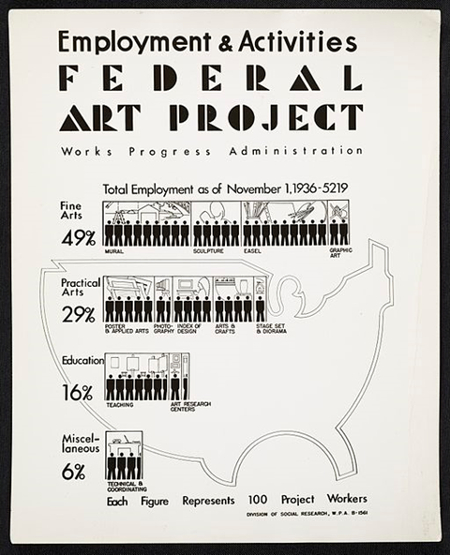
WPA Federal Art Projection Poster, 1936. Public Domain via Wikimedia Commons.
The federal arts programs initiated in the 1930s were intended to alleviate the economic hardships of unemployed cultural workers, to popularize art among a much wider segment of the population, and to boost public morale during a time of deep stress and pessimism, or as New Bargain artist Gutzon Borglum remarked, to "coax the soul of America back to life."
The best known of all the programs that were enacted during the Depression was the WPA (Works Progress Administration) Art Projection. It consisted of four distinct projects: a Federal Art Projection, a Federal Writers' Project, a Federal Theatre Project, and a Federal Music Project.
Paintings were given to government offices, while murals, sculptures, bas relief, and mosaics were seen on the walls of schools, libraries, post offices, hospitals, courthouses, and other public buildings. Over the course of its viii years, the WPA commissioned over v hundred murals for New York City's public hospitals alone. Among the now well-known artists supported past these programs were painters such every bit Thomas Hart Benton, Jackson Pollack, Willem de Kooning, Raphael and Moses Soyer, and the sculptor, Louise Nevelson.
The impress workshops set up up by the WPA prepared the footing for the flowering of the graphic arts in the United states, which until that time had been limited in both media and expression. Moreover, since prints were portable and cheap, they became a vehicle for broadening the public's understanding and appreciation of the creative arts.
Some 100 community fine art centers, which included galleries, classrooms, and community workshops, were established in twenty-two states–but particularly where opportunities to experience and brand fine art were scarce. Through this attempt individuals who may never have seen a large painted scene or a piece of sculpture were given the opportunity to experience not only a finished work of art but to participate in the creative process. In the New York Urban center expanse alone, an estimated 50,000 people participated in classes nether the Federal Art Project auspices each week. According to Smithsonian author, David A. Taylor, "the effect was electric. It jump-started people beginning careers in fine art amid the devastation."
The Federal Writers' project provided employment and experience for editors, art critics, researchers, and historians, a number of whom afterwards became famous for their novels and verse, such as Richard Wright, Ralph Ellison, Studs Terkel, and Saul Blare. They were put to work writing state and regional guidebooks that were to portray the social, economic, industrial, and historical background of the state. These guidebooks represented a vast treasury of Americana from the ground upwardly, including facts and sociology, history and legend, and histories of the famous, the infamous, and the excluded. There were too seventeen-volumes of oral histories of the last people who had lived under slavery. An boosted set of folklore and oral histories of 10,000 people from all regions, occupations, and ethnic groups were nerveless and are now held in the American Folklife Middle of the Library of Congress.
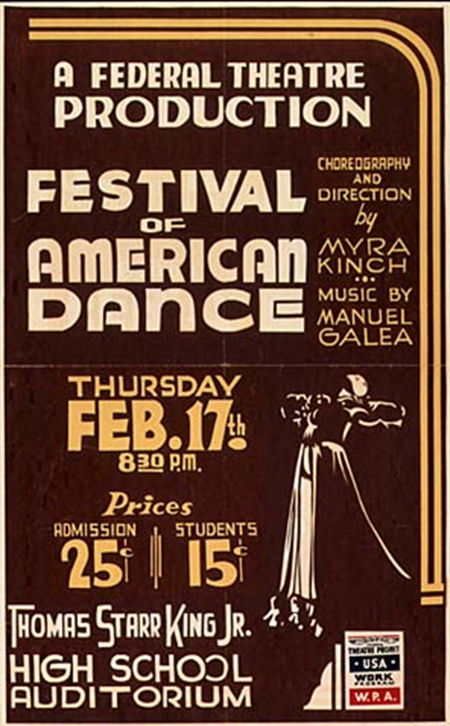
Federal Theater Projection poster, 1938. Public Domain viaWikimedia Commons.
The Federal Theatre Project was the first and only attempt to create a national theatre in the United States, producing all genres of theater, including classical plays, circuses, puppet shows, musical comedies, vaudeville, trip the light fantastic performances, children's theatre, and experimental plays. They were performed wherever people could assemble—not just in theaters, but in parks, hospitals, convents, churches, schools, armories, circus tents, universities, and prisons. Touring companies brought theater to parts of the state where drama had been non-existent, and provided training and experience for thousands of aspiring actors, directors, stagehands, and playwrights, among them, Orson Wells, Eugene O'Neill, and Joseph Houseman.
The programme emphasized preserving and promoting minority cultural forms. At a fourth dimension of strict racial segregation with arts funding not-real in African American communities, blackness theatre companies were established in many cities. Foreign language companies performed works in French, German, Italian, Spanish, and Yiddish.
The Federal Theatre Project also brought controversial problems to the foreground, making it one of the most embattled of all the New Deal programs. Its "Living Newspaper" section produced plays nigh labor disputes, economical inequality, racism, and similar issues, which infuriated a growing chorus of conservative critics who succeeded in eliminating the programme in 1939.
The Federal Music Project employed fifteen,000 instrumentalists, composers, vocalists, and teachers also every bit providing financial assistance for existing orchestras and creating new ones in places that had never had an orchestra. Many other musical forms—opera, band concerts, choral music, jazz, and pop–were also performed. Most of the concerts were either gratis to the public or offered at very depression cost, and free music classes were open to people of all ages and abilities.
In improver to the arts programs, the Subcontract Security Administration's photography program oversaw the production of more than 80,000 photographs, as office of the endeavour to make the nation aware of the plight of displaced rural populations. These images–produced by photographers such as Walker Evans, Gordon Parks, and Dorothea Lange helped humanize the verbal and statistical reports of the terrible poverty and turmoil in the agricultural sector of the economy and brought documentary photography into the cultural pantheon of the nation.
Between 1933 and 1942 ten chiliad artists produced some 100,000 easel paintings, eighteen,000 sculptures, over xiii,000 prints, four,000 murals, over ane.half dozen million posters, and thousands of photographs. Over a grand towns and cities now boasted federal buildings embellished with New Bargain murals and sculpture. Some 6,686 writers produced more than a chiliad books and pamphlets, and the Federal Theatre Project thousands of plays. More than than the quantity of the output, however, is the way in which these programs shaped Americans' understanding of who they were equally a people and their country's possibilities. Before the New Deal, the notion that government should back up the arts was unheard of, only thanks to the New Deal, art had been democratized and, for a time, de-commodified, made attainable to the cracking majority of the American people.
Peradventure Roosevelt himself best summed up the significance of the New Deal arts programs:
A few generations ago, the people of this state were often taught . . . to believe that art was something foreign to America and to themselves . . . But . . . inside the last few years . . . they accept discovered that they take a part. . . . They accept seen in their own towns, in their own villages, in schoolhouses, in post offices, in the back rooms of shops and stores, pictures painted by their sons, their neighbors—people they have known and lived beside and talked to. . . some of it proficient, some of it not so good, but all of it native, human being, eager, and alive–all of it painted past their own kind in their own country, and painted almost things that they know and look at often and have touched and loved. The people of this country know now . . . that fine art is not something just to be owned merely something to be made: that information technology is the act of making and not the act of owning that is art. And knowing this they know besides that art is not a treasure in the by or an importation from another state, but office of the present life of all the living and creating peoples—all who brand and build; and, nigh of all, the young and vigorous peoples who have fabricated and built our present broad country.
New Bargain support for the arts had coaxed the soul of America dorsum to life, but we are in danger of losing information technology again. Under the obsession with deficits, arts programs in the public schools are being cut, federal funding for the arts has dropped dramatically, and even individual funding has been reduced. Without art, nosotros are ill-equipped as a people with the commonage imagination that is needed if nosotros are to resolve the enormous challenges that face us in the xx-first century. Who or what will there exist to coax this generation back to life?
This article first appeared at the OUPblog.
Featured image credit: Ketrin1407 (Creative Commons By)
Please read our comments policy before commenting.
Note: This article gives the views of the author, and not the position of USApp– American Politics and Policy, nor of the London School of Economics.
Shortened URL for this post: http://fleck.ly/1iEEtWE
_________________________________________
About the author
Sheila D. Collins –William Paterson University
Sheila D. Collins is Professor of Political Science Emerita, William Paterson University and editor/author with Gertrude Schaffner Goldberg ofWhen Government Helped: Learning from the Success and Failures of the New Deal. She is on the speakers' bureau of the National New Deal Preservation Association and the lath of the National Jobs for All Coalition, is a member of the Global Ecological Integrity Grouping and co-chairs two seminars at Columbia University.
Source: https://blogs.lse.ac.uk/usappblog/2014/03/29/when-art-coaxed-the-soul-of-america-back-to-life/
0 Response to "How Did the Federal Art System Affect Confidence Building"
ارسال یک نظر